
The Dice — 040
Yesterday my order for print zines arrived and I immediately saw every flaw and mistake made. My design work assumed real zine-like printing where every page is used, including the inside of the front and back cover. Maybe I made the wrong paper choice but the copies I got are womperjawed. One of the reasons I dropped everything to get into web design is the constant difficulties I had with print publications—especially when working alone.
I spent many years hunched in front of the monochromatic blue glow of a nine-inch Macintosh screen making signs, posters, flyers, brochures but without the ability to print anything out until I got to the print shop weirdly called TimeFrame. There were a few times that I opted to personally pay for a second print run after discovering flaws after seeing the finished print job. Which was not compatible with my state of revenue back then, but I could not deliver bad work. Now here I am decades later back to making pre-print mistakes though I’m in a slightly better position to pay for another run.
Now that I’ve held the books and my zines I have the itch to dive deeper and have started looking into what it would take to start a TimeFrame of my own. This much I know: We need more printed pages in this day and age. I can’t prove it but I’m sure just as our mental health improves by walking among trees it must surely do the same by engaging the written word on paper made from them.
Alright, here’s what I’ve got for you this week.

Infinite Right Answers “is a zine for anyone who’s ever tried to build something weird, heartfelt, and wildly interactive. Part creative manifesto, part behind-the-scenes brain dump, and part choose-your-own-reflection, this zine explores the deeply human art of making stories with your audience, not just for them.” My issue came this week and I loved every page. Especially the bit on finding your flavor profile. Infinite Right Answers is from the creative duo Jeff and Andy Crocker who have an amazing CV in creative work for creative places. Each issue comes with a few worksheets and a sweet branded Sharpie.

People continue to ask what design tools I use these days. Seems there are still people out there who are either forced to continue using Adobe or they're nervous to make the jump. Well I'm here to tell you, go ahead and jump, I've got you. Nobody on this planet should be using Adobe products in a world where Affinity exists. None. Zero. If you're holding back because you don't want to have to learn a new application then I question your intelligence and life decisions.
Affinity used to be a family of three tools: Design, Photo, and Publisher, but they recently pulled everything into a single application (and file type). In short, they simplified the platform but added a large handful of new and powerful features. The best part is that it's 100% free and, unless you pay an additional fee, does not include AI. Yes, you read that right.
Here's a good overview of everything in the new Affinity.
I'm in my fourth year using Affinity tools for everything I can. I only use Figma when I have to collaborate, but after I get used to this new application I might ditch that as well and fall back on old collaboration methods that involve red pens.

AI 2027 is a report from the AI Futures Project based on the work of a ton of contributors. "Daniel Kokotajlo, Eli Lifland, Thomas Larsen, and Romeo Dean wrote the content of the scenario and endings. AI 2027 was informed by experience from more than a dozen tabletop exercises with hundreds of different people."
There are a few reasons to share AI 2027. First and foremost is to experience the data visualization that must be experienced on desktop to be fully appreciated. As you scroll through the months and years, the dashboard in the upper right updates in real time. I wish it was bigger.
Second, and most important is the actual content of the report itself. It's futures scenario planning mapped out month by month, year by year until October 2027. The narratives read like a future issue of The Economist's annual The World Ahead documenting trends in technology, economics, geopolitics, and society as they are impacted or impact AI.
And now a word from our sponsor...
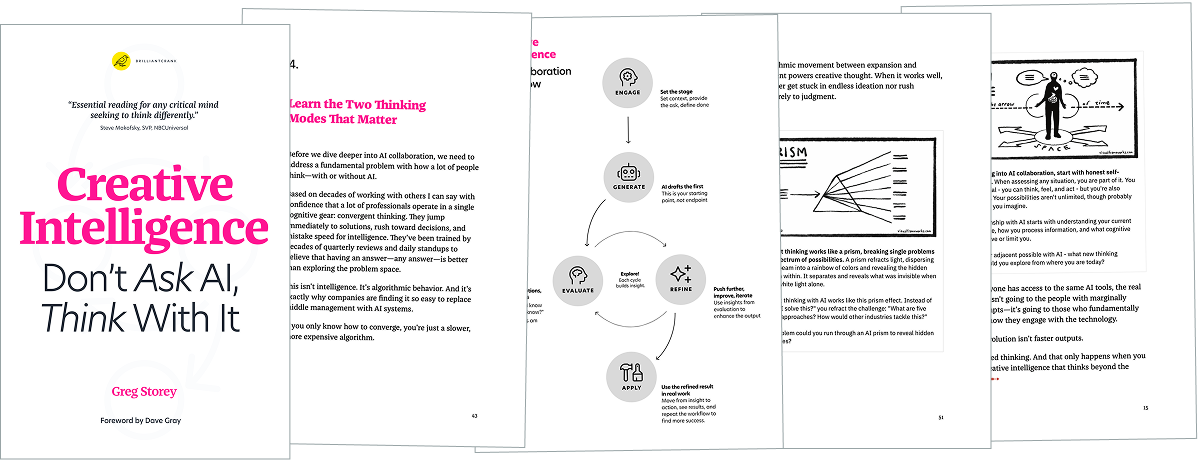
Creative Intelligence is the foundational framework for AI collaboration that transfers across every tool and platform. Learn why most AI training creates false confidence, how to validate AI outputs, and the thinking modes that distinguish expertise from execution.
Buy it now in digital or print..

And now for something completely different, read Kim Cross’ long read on wild Alaskan salmon. She starts in Bristol Bay by joining a setnet crew and countinues her journey with a chef who knows how to cook salmon properly. “I’ve chosen Alaska for my salmon quest because I want to witness natural abundance. The world’s largest self-sustaining wild salmon runs are sockeye returning to Bristol Bay, “the mother lode of wild Alaskan salmon,” as one fisherman puts it. About the size of Virginia, Bristol Bay is the easternmost pocket of the Bering Sea, the vast cold stretch of ocean between Russia’s Kamchatka Peninsula and Alaska’s Aleutian Islands. All five species of Pacific salmon live here: sockeye, king, coho, pink, and keta.” Side note: Cross is accurate about the Copper River King being the absolute best salmon on the planet.
It’s also worth noting that when looking up Kim from the link in her article bio, I was surprised to discover that she too was published in the first issue of Geezer magazine. What a small world.


No matter your preference for domicile format, you should all subscribe to the wonderful magazine, Never Too Small, "a window into this world for inspiration and leadership in Small Footprint Living." It's a global quarterly publication with stories on dwellings, occupants, and lifestyles. I dig that small-footprint living is a form of resistance to consumer culture and extraction systems. Choosing less space means choosing less stuff, less maintenance, less of your life spent acquiring and servicing possessions.
Never Too Small shows you what that actually looks like in practice, not as deprivation but as deliberate design.
The feature, Character Driven, is a great showcase of the type of storytelling and photography you can expect from each issue. It's about Loo Lok Chern, a graffiti artist who lives in Kuala Lumpur but his work is featured around the world.
Each issue is hefty, almost book-like. Like Monocle there are inserts and special sections where the paper, printing, and design standout from the rest of the issue. Anyone who considers themself a print aficionado needs to grab a subscription. If you're not into print yet, holding Never Too Small in your hands will immediately convert you.

Let's end this issue on a high note. DC Comics announced that the groundbreaking and amazing imprint, Vertigo, is coming back in 2026. Beginning in February Vertigo will roll out with issue #7 of DC Black title, The Nice House by the Sea, followed by a slew of brand new books. Even more new titles will debut later in the year including Necretaceous with this fantastic setup: "There are many theories about the extinction of the dinosaurs. They're all wrong." 100 Bullets is coming back with a new run and I'm happy to see Ram V is a part of the fray with this premise, "Occult warfare was only a fantasy, dead and debunked…at least that's what they'd like you to think." I don't know about you, but I'm ready for this.
Meanwhile, the new Absolute Martian Manhunter is not to be missed. And if you missed it before then don't miss Warren Ellis' must read, Transmetropolitan. I could go on, but I will save more recommendations for future issues.
Having said that, I've got one more recommendation for parents with kids who want to read comics, but you're not sure if they're ready for the mainstream stuff. Bone by Jeff Smith, an Eisner winner, is written for everyone. It's a long beautiful story with artwork that amplifies the building narrative into a huge ending. A must read for everyone.
Published in Tacoma, Washington while signing along to Homogenic by Björk.
Member discussion