
The Dice — 046
I was about to write “what a weird time” and then scrambled trying to recall a time when it was not. An altogether fruitless exercise and certainly not the Stoic thing to do. Earlier this year Data Storey and I decided that waiting for the world to return to "normal" as a means to reduce the risk of making change is pointless. So, later this year we're moving south, back into the part of the world that doesn't live under the oppression of the polar jet stream. I've now spent twenty six years of my life living above 45° latitude. There will not be a twenty seventh.
It's time to make moves. I'm done waiting on systems I can't control to align more comfortably with my values before I get on with life. That feels more and more like sitting on my hands inside a burning house. Everything is not fine — it's never going to be fine, it never was — and waiting until it is is bullshit.
While the world does all of the things that are hard to process with ever increasing velocity thanks to technology, we can't sit around and wait. Otherwise we're letting others dictate our lives.
To help myself and others I've come up with a simple rubric, a way to gauge if what's coming at me is something I need to worry about while also keeping my own output in check.
I call it Signal vs. Bullshit. Signals create trust. Bullshit corrodes trust. If you're not creating or looking for signals, then you'll find yourself deep in bullshit. I've been working on this for a while now and it's helped me get my mind in a better place. It's amazing what an I/O function can do to make decisions simple.
Let's blow the dust off The Dice and roll.
Alright, let's roll.

If Henry's manifesto is the argument for leaving the corporate web, DFOS is the argument for where to go. It’s a path for the Open Web where the rules aren't set by an algorithm trained on someone else's bullshit stock-bump KPIs.
Seven years ago Yancey Strickler published The Dark Forest Theory of the Internet and it touched a lot of nerves. The idea continued to build until the public release of a platform dedicated to rewilding the internet last year. Dark Forest OS, or DFOS for short, is "a platform where every community designs its own internet." Though it has similarities, DFOS is much more than a Circle clone, starting with a core belief and protocol that "the most meaningful creative and social coordination on the internet happens in private groups, closed communities, invite-only spaces. The topology is private-first." It appears they're off to a good start.
I'd love to see them acquire and incorporate mmm.page to bring back the pre-Bootstrap web experience. Right now it has a bit of a GeoCities vibe sans the blink tag, which is kind of a shame because if you think about it, the world started turning to shit when browsers stopped supporting it. Let’s bring that mojo back.

We are loving the World Cup but a recent delivery reminded me of how sharp the Summer Olympics in Paris 2024 were. Olympic Games. Paris 2024 by Markus Osterwalder is an add-on to his two-volume Olympic Games. The Design, which covers more than one hundred years of branding and wayfinding. The Paris volume is a complete record and a solid addition to the design library.
Otl Aicher's work for the Munich games in 1972 has been a longtime favorite, but the work Joachim Roncin and his team delivered just a few years ago is the new bar for international brand and design systems. This is a book I'm glad to have in the library to study, draw inspiration from, and spark happy memories.
Two more books that are certain to be delivered to Storeyhouse in the future:
Off Course: The New Cool in Golf explores a sport “once bound by hierarchy and etiquette, the game is now reimagined by a generation playing on instinct.” I’m not really into golf, but this looks beautiful.
LAND explores the evolution of the Land Rover “through a design-led lens, showcasing bespoke restorations and conceptual reworks by builders, designers, collectors, and adventurers worldwide.” I’ve never owned a Land Rover, but I’m intrigued to learn more through the gorgeous photography.

Speaking of the World Cup, just as the American team has improved so has the commentating by mostly everyone. As the bar for quality analytical engagement rises the clowns are easily exposed. And thus, it would seem the press has had enough of American-Soccer-Jon-Tesh aka Alexi Lalas. Just read this opening from The Guardian’s article length critique on Alexi:
He’s the ranter whose rants never actually say anything, the life of the party at the party no one enjoys attending, the “big personality” who’s always misjudging the size of the room. He’s corporate America’s idea of a fun guy, the type of workplace “character” whose business trip hangover never stops him from being first at the hotel breakfast buffet, hair wet, Untuckit shirt untucked. He would absolutely dominate karaoke night at a conference on infrastructure finance. If only this were the limit of Alexi Lalas’s actual impact on the world, our culture would live in blessed ignorance of his existence.
Yikes, but accurate. Here’s another from closer to home in the Athletic:
He is one of the most insufferable analysts in American TV sports history. His broadcasting skills are third division next to [Rebecca] Lowe’s.
There was a time when we the American audience didn’t know any better, but to the credit of Rebecca Lowe and her co-hosts of the Premier League on NBC, they’ve matured our expectations for analysis of the beautiful game. I could not stand John Tesh as a commentator and after years of receiving better articulation and commentary, Alexi needs to find something else to do.
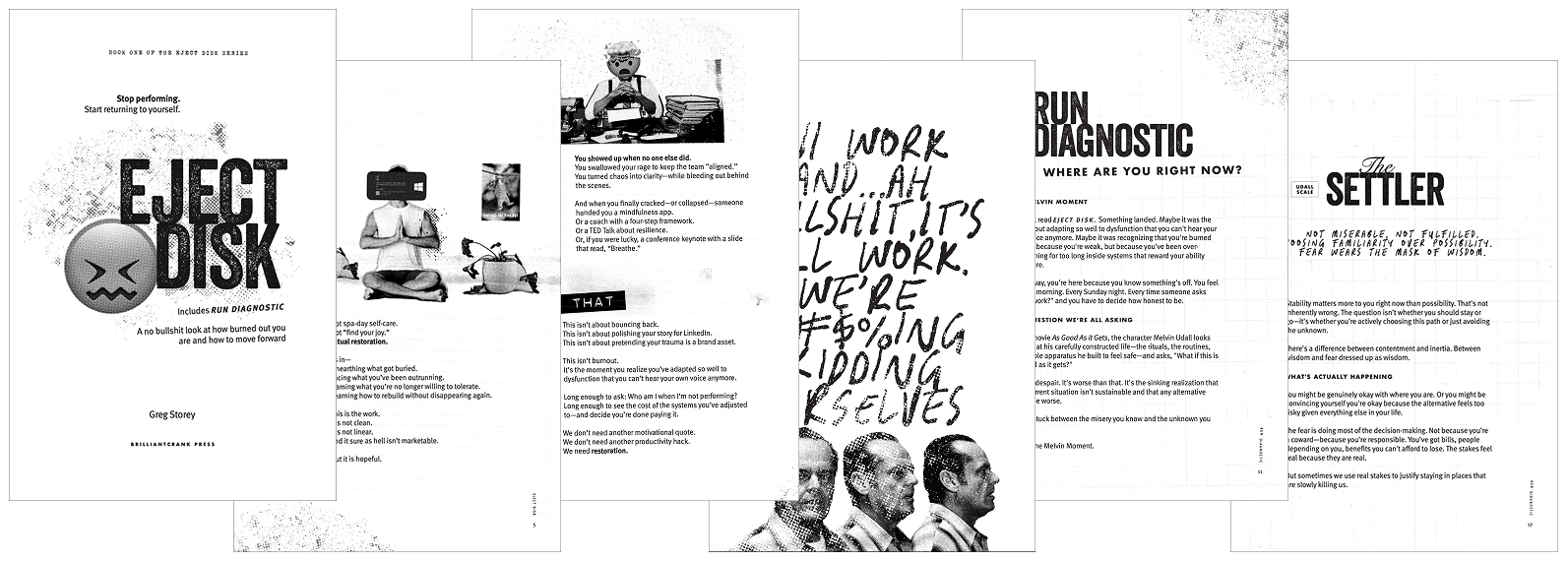
Most of us are stuck. Stuck in jobs that are grinding us down. Stuck searching for work that won't come. Stuck between desperately wanting change and being terrified of what that change might cost. Eject Disk is a call to action to name these feelings and do something about them. And now I want you to have your own copy.
No strings. No drip campaigns. Just grab it, read it, and feel it.

The evidence on cognitive damage due to a reliance on AI continues to trickle in. I’ve written about this several times and will continue to do what I can to keep this problem top of mind. Yes, the pun very much intended while I still have the brain matter to do so.
Concerns about the effects of depending too much on AI, and even other forms of technology, aren’t new. Calculators and GPS devices have dulled the ability to do mental math and navigate neighborhoods without assistance. A 2025 Lancet study found that doctors who use AI classification tools to detect cancer eventually became worse at doing so on their own. A neuroscientist at the Possibility Institute, a metascience research group, recently warned that diverting too much of one’s thinking to AI can weaken the brain’s defenses against dementia.
TL;DR — If you don’t want to end up as a character from WALL-E, then Don’t Ask AI, Think With It. Come on, you had to see that coming, right?
Seriously if you want to counter this negative impact, Harvard Health recommends continually building your cognitive reserve.
You can think of cognitive reserve as your brain's ability to improvise and find alternate ways of getting a job done. It reflects how agile your brain is in pulling in skills and capacities to solve problems and cope with challenges. Cognitive reserve is developed by a lifetime of education and curiosity.
How do we do this? Simple: Eat plants, exercise, sleep, de-stress, “continue to challenge your brain”, and—this is the hard one for most of us—nurture connections with humans. In short, get Paleolithic.
I have more research to share on this topic and the limits we need to impose on ourselves to reduce cognitive decline while making use of AI more productive. Stay tuned.

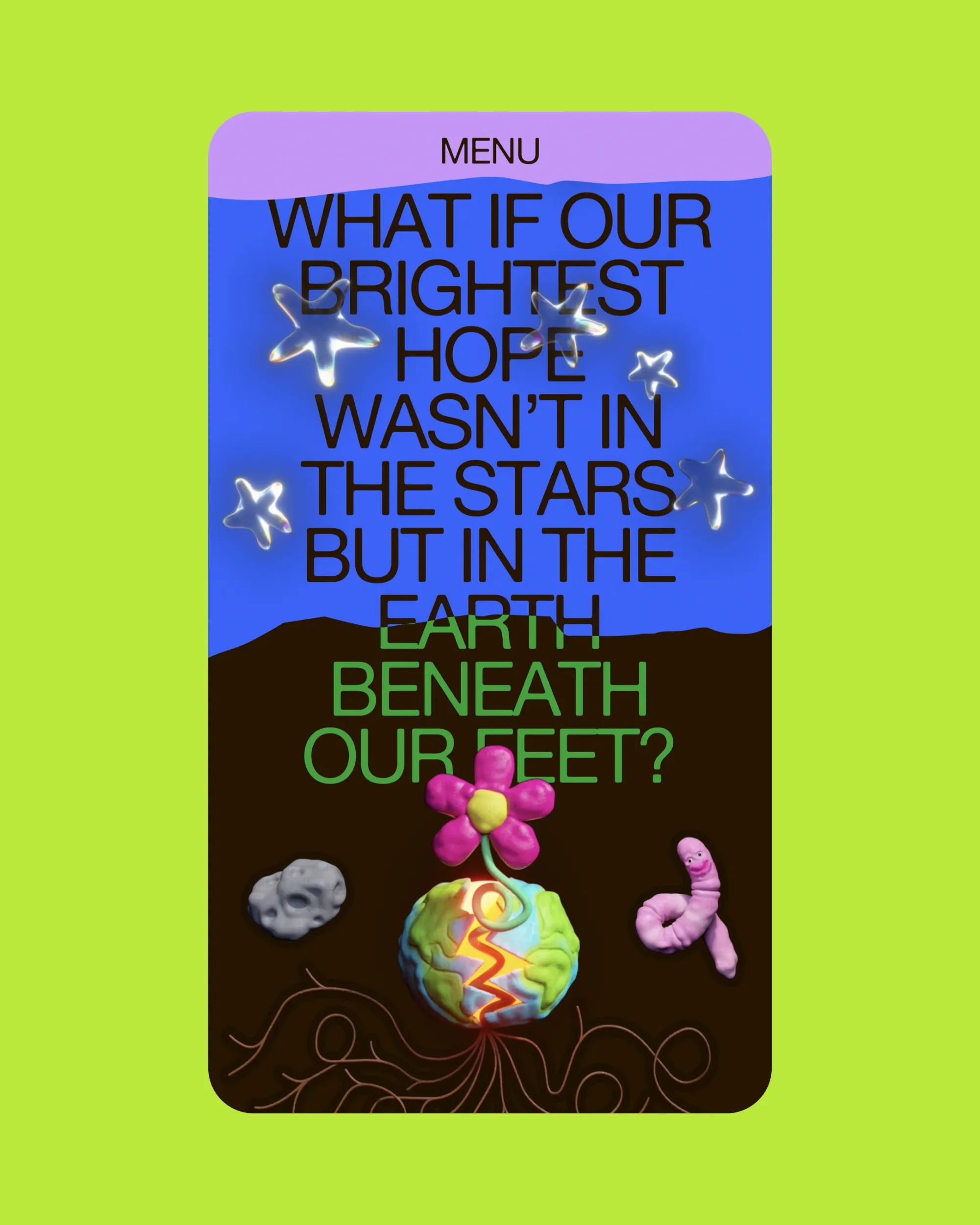
We’ve all heard about cyberpunk, and maybe you’ve heard about solarpunk, but I’ve got a new one for you: soilpunk. LFG!
And like all good things punk, there is a magazine for it. Tractor Beam is “a quarterly speculative and science fiction publication dedicated to soilpunk.” It’s Nice That recently introduced the publication, its creative direction, and the people behind it. “Tractor Beam started by questioning how soil-as-technology might shape future visions of life on Earth. History shows that fictional futures are a blueprint for actual futures.” This movement and publication is also proof that there is more to the world than non-stop jibba jabba—including from myself—about AI.
Before moving on, here’s more punk energy from Barcelona with LOW←TECH MAGAZINE. “There is a lot of potential in past and often forgotten knowledge and technologies when it comes to designing a sustainable society. Interesting possibilities arise when we combine old technology with new knowledge and new materials.” The website is solar powered and sometimes goes offline in bad weather.

Immediate reactions to President Obama’s new presidential library are mixed and polarized. That means the design has done its job in two ways. It is a singular icon of architecture with Chicago—the capital city of architectural wonder—standing in the background. And it has us talking. In conversation. No matter how you feel, it is an intriguing addition to our presidential libraries that is wonderfully unique.
In a short film on the design of the building, architect Billie Tsien said, “We wanted a building also that had an emotional feeling to it. So this idea of a building that's changeable, kind of like we're all changeable, is something that felt really important. Even if the shape tries to remain sort of elemental, the material from which it's made shifts and changes with light and time of day and the weather.” The shape of the building comes from a concept of four hands reaching up and connecting. “When you bend your hands—putting different hands together to hold a volume of light or life—that was a thought that there was something precious inside.”
Inside there is also a fully functioning public library and Tafari’s Kitchen, a restaraunt named after Tafari Campbell. Tafari served the Obama administration and later the Obama family. He sadly died in a paddleboard accident a few years ago.
I hope to visit this space one day because I bet the photos don’t do it justice.
Published in Tacoma, Washington while listening to The Essential Mix live in Washington DC with BT by way of Jason Kottke many, many moons ago.
Member discussion