
The Dice — 043
The Internet might be dying, but it still has it moments of serendipity. A comment on LinkedIn led me to a blog with a recent post on the Freedom of Missing Out. “We should not fear of missing out. Instead, let’s normalize a freedom of missing out. A freedom to let the insignificant and immaterial slide into the ether unnoticed. A freedom to be bored or reflective. A freedom that honors stillness and slowness. A freedom that empowers a focused mind, time spent with meaning, and whole presence in any given moment.” This is very much related to this week’s roll on drawing mandalas.
I received a few responses to last week’s roll about You’re Always Missing Out because I completely borked the acronym. Which is a shame because it perfectly sets up one of the greatest lines in film: “If I hear YAMO be there one more time I’m going to YAMO burn this place to the ground.” So consider this the definitive correction.
Have a safe and happy holiday this week.

This year the Storeyhouse Critereon film collection grew substantially with many films previously unseen. Years ago I wouldn’t have given many of the titles a second glance, but my curiosity is piqued when I hear creatives and makers provide their perspectives on what makes films meaningful and worth attention.
Every semester in college I added HIST A244 Studies in Film History by Ron Crawford to my schedule. We met every Monday evening in large theatre where Ron gave a lecture on film history followed by the viewing of a movie essential to the theme of the class.
This week I stumbled on a conversation between Leonardo DiCaprio and Paul Thomas Anderson where they discussed a long list of films that include Star Wars, The Battle of Algiers, Animal House, The Searchers and many more. Throughout they discuss backstories and influences these movies had on their career and in the development and performance of their movie One Battle After Another. Highly recommended whether you have watch the movie yet or not, but you are going to watch it.
Side note: I was surprised to hear how both men appreciate Midnight Run. It is one of my all-time favorite movies that never gets old nor fails to entertain even as I know some of the dialogue by heart.

Marcin Wichary’s post on “clock indents” was new to me but thankfully like most of his wonderful writing, it’s timeless.
“In Poland, in the 1980s, the dead space in between programs was filled with…a clock. Or, to me, The Clock. I simply loved The Clock to death. Not for what it was, of course (time-telling was provided by our own wall clock that didn’t require aerials and cathode ray tubes — and later on, a prized Casio electronic watch on my wrist). Like Pavlov’s dogs, I loved The Clock for what it promised. I would stare at it just minutes before new adventures of Crockett and Tubbs. I would twiddle my thumbs in anticipation of the resolution to last week’s Crime Story — or, in the years before I was allowed to watch those series, another episode of a Polish, Czech, or Russian cartoon.”
I hope you enjoy this rabbit hole as much as I did.

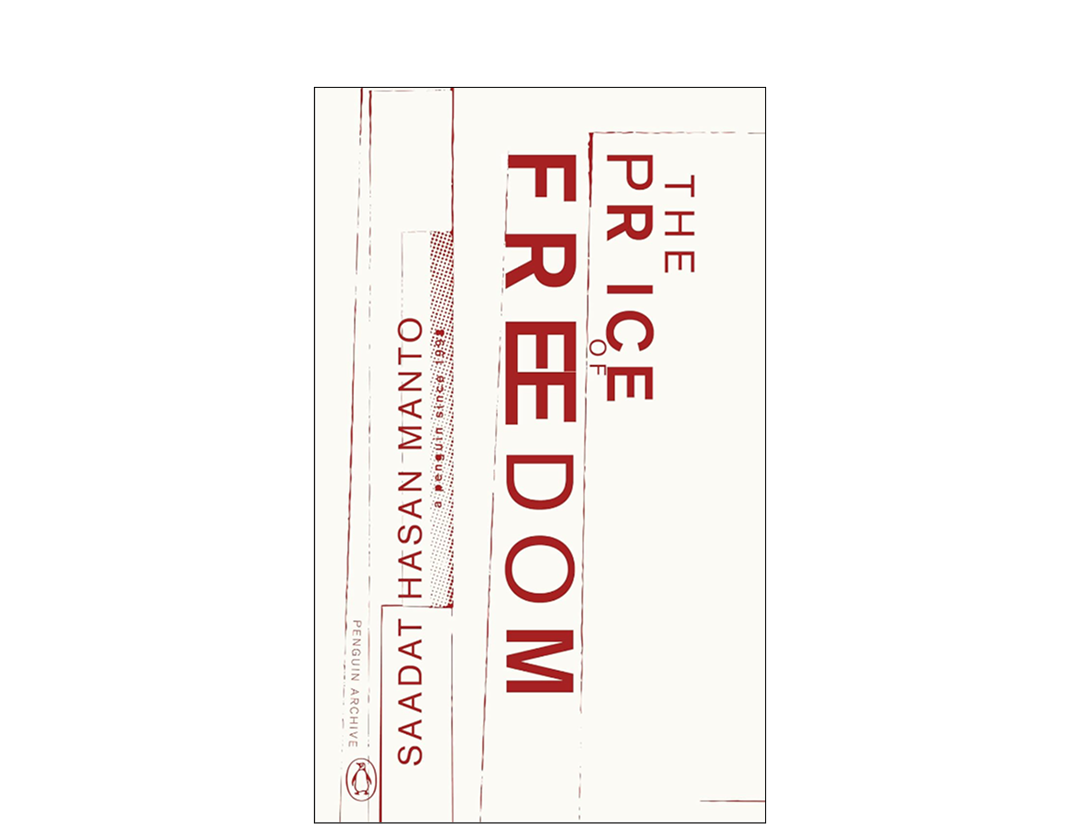
Book cover retrospectives make the very best “best of…” lists this time of year and this one by The Causual Optimist is top notch. This list kicks off with a hot, monochromatic series that immediately caught my attention. “The typographic covers for the
Penguin Archive designed by Jim Stoddart. Published in April to celebrate 90 years of Penguin Books, the designs use typography to evoke the different eras of the publisher.”
To appreciate the depth and breadth of Jim’s work, check out more of the collection as just a few images aren’t enough. I would like to see the entire set some day but I’m going to call it now: the cover for The Price of Freedom by Saadat Hasan Manto (see above) is the best of the set—for obvious reasons. But honestly there are so many amazing covers in The Casual Optimist’s list are worth worth savoring.
New York Times Book Review art director Matt Dorfman has a nice curated list of notable covers. Super interesting is the cover for Searches by Vauhini Vara with what looks like AI generated overview of the book and the cover image. “It’s counterintuitive to market a book with a presentation this deliberately alienating, even if alienation from the self is one of its key themes. Praise is due for recognizing the opportunity to attract attention by setting the sterile informality of a ChatGPT overview against a sea of other books trying hard to look more considered.”
Meanwhile, there is a similar list for my favorite medium, but unlike books, the real creativity is not on the cover but within.
Get the Eject Disk zine for free.
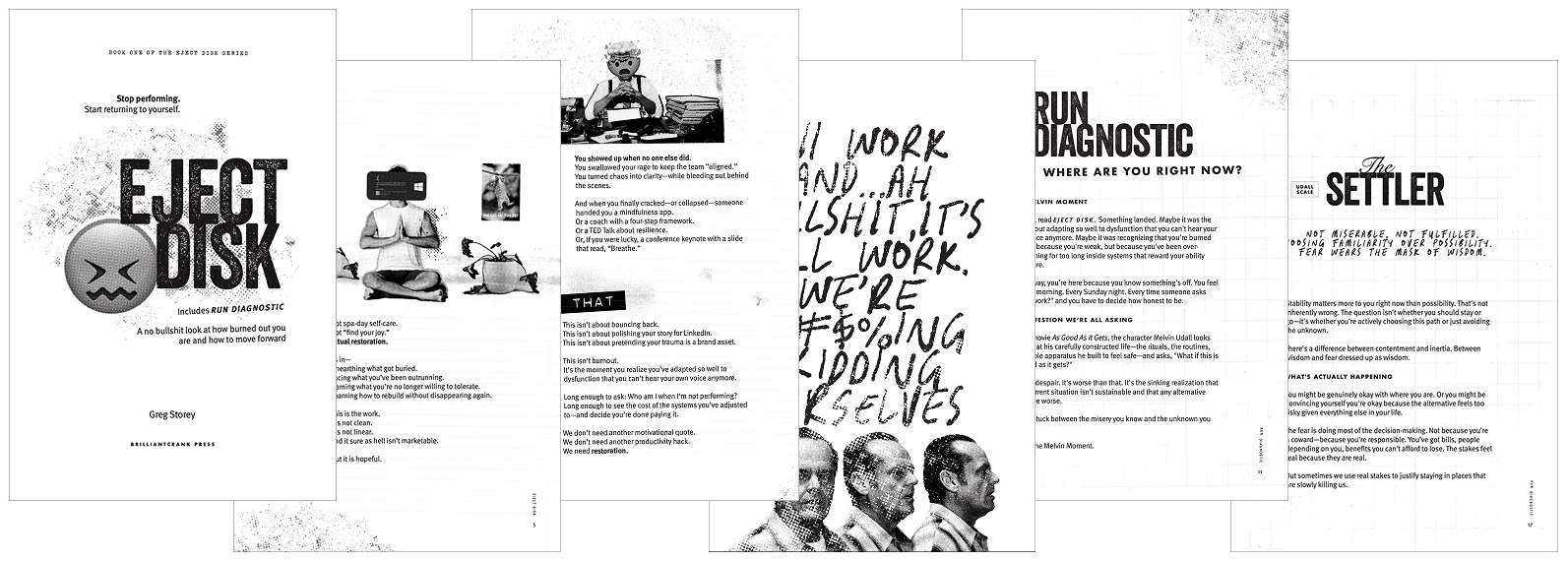
Most of us are stuck. Stuck in jobs that are grinding us down. Stuck searching for work that won't come. Stuck between desperately wanting change and being terrified of what that change might cost. Eject Disk is a call to action to name these feelings and do something about them. And now I want you to have your own copy.
Just grab it, read it, and feel it. And if you're on Reddit, give this a bump.

If you’ve been around and were there when blogs became a thing, then you’ll appreciate Talking Points Memo’s Pivots, Trolls, & Blog Rolls: Reflections on 25 Years of Digital Media.
So far my favorite entry is This Post Should Have Been Shorter by Hamilton Nolan on blogging as journalism.
“Newspaper and magazine stories come with a built-in frame. They have word counts. Even books, the pinnacle of Serious Writing, have their limits: a hundred pages is too few, a thousand is too many. On the internet, there is no word count. Indeed, there are almost no limits of any kind. At some sites, for every news item or essay or feature story, a lone blogger was tasked with deciding how long it should be, how serious or funny it should be, and how it should be presented on the page. This caused much unpolished crap to be published online, sure. But those who mastered the craft of blogging did a job that requires three editors and a graphic designer at a major newspaper. And they could make it funny, something that no number of New York Times editors can achieve.”
Columbia Journalism Review has an interview with TPM founder and publisher Josh Marshall, who was a monumental figure in proving that good blogs have an important role to play in journalism.

When I caught a glimpse of Power Tools I could not click download button fast enough. It’s a new zine by Bart Fish dedicated to “critiquing AI and the billionaire toolmen behind it. The name is based on the common narrative that AI just a tool. This zine asks readers, ‘a tool for whom?’ We’re not anti-tech, we’re against irresponsible tech, the kind that steals, exploits, and endangers humans in the name of progress.”
Though you might have a different or slightly different take on this new technology, as I do, it is important to support Power Tools and others like it. We all need to consider different perspectives that come from real people, not networks, corporations, politicians or—for fucks sake—tech oligarchs.
The download is free, but I highly recommend buying the print edition that comes with a sweet sticker pack while supplies last. It’s also worth noting that Bart is looking for contributors for future issues.
Speaking of zines, The Guardian brought attention to more and more people making, folding, and distributing zines as a form of resistance. “Zines have made a resurgence in recent months as communities seek to share information, such as how to protect one another from Immigration and Customs Enforcement (ICE) or how to resist the Trump administration outside No Kings protests. People of all ages, from all regions, are making, printing and distributing zines on the streets, in libraries and at local gathering spots.” More of this please, and maybe through in a pirate radio station or two?

Every Friday morning at 9am PST, Dave Gray kicks off his campfire call. I try to make it every week, even if it’s only for a bit because I get to see and interact with people from all walks of life and from all over the world—no membership required. Each call is filled with divergent conversations that get sparked by curious people with an interest in learn and share what they’re writing, crafting, making, doing—you get the idea.
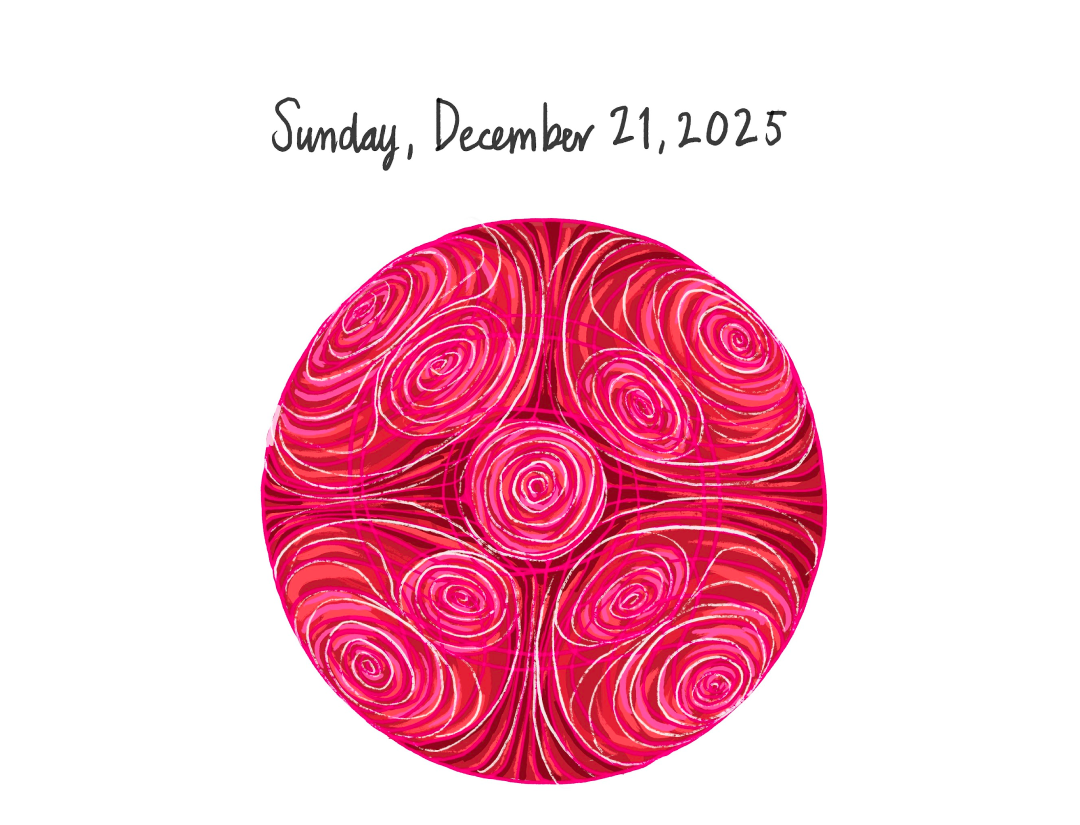
This week our conversation got off with a bang after Dave shared that he has recently start drawing mandalas every morning. The practice of creating a mandala starts with drawing a simple circle and letting your mind wander as you fill it in. Said Dave on the call, “the mandala is sort of like an invitation to that part of the mind which doesn't speak in language. It's an invitation to the unconscious, that part of the brain or the mind to reveal itself or talk to me.”
The results are striking and I was immediately drawn in to learn more as the results—at least for Dave—are wonderful works of art. The mandala from December 15th is my favorite to date.
Published in Tacoma, Washington head nodding to Cabin in the Sky by Da La Soul.
Member discussion